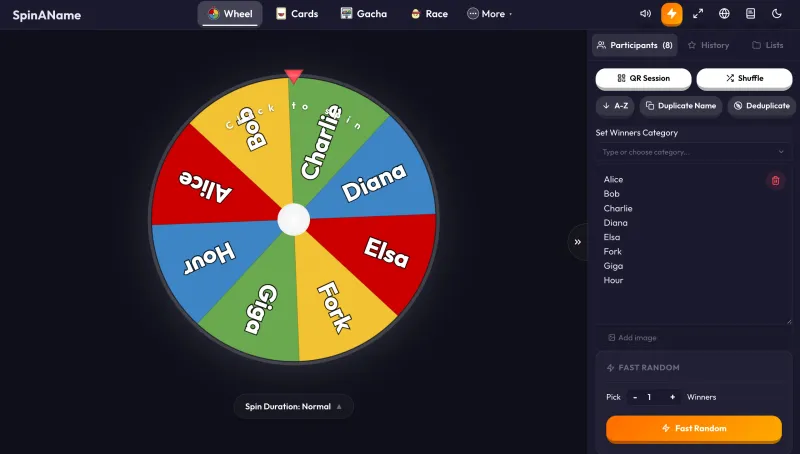
There's a name for the exhaustion you feel after making too many small decisions in a day. It's called decision fatigue, and it's a real thing. By the time you've answered 50 emails, picked what to wear, and figured out your morning schedule, your brain is running on fumes. Then someone asks, "Where should we eat?" and you just... can't.
A random picker won't solve the big decisions in your life. But for the small ones that eat up way more mental energy than they should? It's genuinely useful.
1. What to Eat (The Universal Struggle)
This is by far the most common non-work use case. Add your favorite restaurants or recipes to the wheel and spin. Done. Dinner is decided. No more 15-minute negotiations about whether you're "really feeling" Thai food or not.
Try setting a house rule: whatever the wheel lands on, that's dinner. No vetoes. The constraint is the whole point — it removes the negotiation entirely and gets you to a decision in seconds.
Pro tip: make a saved list for your go-to spots. That way you don't have to re-enter them every time. Just load the list, spin, and eat.
2. What to Watch Next
You know the drill. You open Netflix, spend 25 minutes scrolling, and end up rewatching The Office again. The problem isn't a lack of options — it's too many options.
Some people have started keeping a "watch list" in their notes app. When they can't decide, they dump the list into a random picker and let it choose. It sounds silly until you realize you just saved half an hour of scrolling and actually watched something new.
3. Task Prioritization When Everything Feels Urgent
When you have six tasks and they all feel equally important, add them to a wheel and spin. Whatever it lands on, you do first.
The logic is that if they're all roughly equal priority, the order doesn't actually matter — but your brain will keep going in circles (no pun intended) trying to optimize. The wheel breaks the loop and gets you moving.
To be clear, this doesn't work when the tasks genuinely have different urgencies. If one thing is on fire, put out the fire. But for those days when your to-do list is just a wall of equally gray tasks? Pick one and start.
4. Settling Group Disagreements
Board game night and nobody can agree on the game? Spin the wheel. Road trip and the car can't decide on music? Spin the wheel. Office team can't pick a theme for the holiday party? You get the idea.
The nice thing about using a randomizer for group decisions is that it removes the social dynamics. Nobody has to be the one who "always gets their way" or the one who "never picks." The wheel doesn't care about seniority, volume, or persistence. It just picks.
5. Breaking Out of Your Routine
This is the one people don't expect. Add a bunch of activities, hobbies, or places you've been meaning to try. Spin the wheel on a Saturday morning and do whatever it lands on.
Go to that museum you keep walking past. Try the recipe you bookmarked three months ago. Call that friend you haven't talked to in a while. Some of the best experiences come from nudges, and a random picker is a pretty good nudge.
Look, we're not pretending that a spinning wheel is going to change your life. But if you're the kind of person who gets stuck in analysis paralysis over small decisions, having something that just makes the choice for you is weirdly liberating. Try it for a week. You might be surprised how much mental energy you get back.