Quick experiment: think of a random number between 1 and 10. Got it? There's about a 30% chance you picked 7. Humans are terrible at being random, and the research backs this up.
A 1976 study by Kubovy and Psotka found that when people try to generate random sequences, they consistently avoid repeating numbers and overrepresent certain patterns. We think we're being unpredictable, but we're actually being very predictable in our unpredictability.
This might seem like a fun trivia fact, but it has real consequences when we're asked to make "random" selections in our daily lives.
The Bias You Don't Know You Have
When a manager says "I'll just randomly pick someone for this task," what they usually mean is "I'll pick whoever comes to mind first." And who comes to mind first? Usually the person who sits closest to them, spoke most recently, or has a name that's easy to pronounce.
This isn't malicious. It's just how brains work. We take shortcuts. We default to the familiar. But over time, these shortcuts create patterns that aren't random at all.
In classrooms, this means certain students get called on way more than others. In offices, it means the same people keep getting volunteered for extra tasks. In giveaways, it means the selection process isn't as fair as we tell ourselves it is.
What "Random" Actually Means
True randomness means every option has an equal probability of being selected. Not "I closed my eyes and pointed." Not "I asked someone else to pick." Equal probability. Every single time.
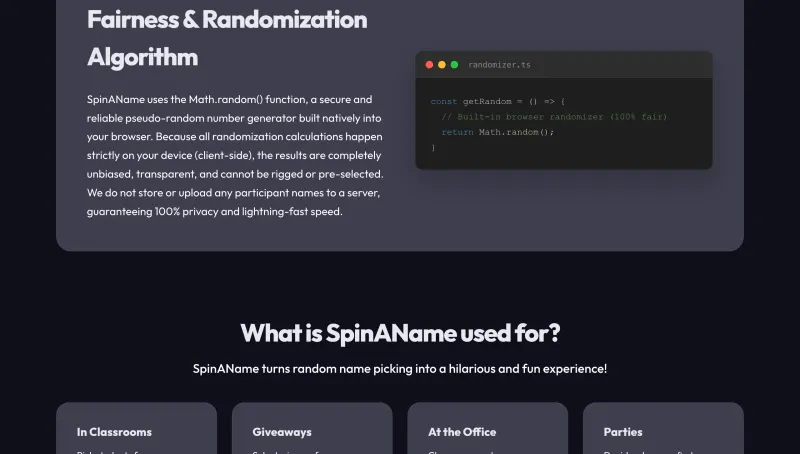
Computers are actually pretty good at this. The Math.random() function that most random pickers use generates numbers using algorithms that pass rigorous statistical tests for uniformity and independence. Is it "true" randomness like radioactive decay? No. But for picking names from a list, it's more than sufficient.
The point isn't that humans are bad. It's that this particular task — making unbiased random selections — is one that computers genuinely do better than us. And there's no shame in using a tool that does a better job.
When Fairness Actually Matters
Some situations are low-stakes. Who picks the restaurant for lunch? Sure, just go with whoever has the strongest opinion. Nobody's getting harmed by that process.
But other situations carry real weight. Who presents at the meeting? Who gets the holiday shift? Who gets selected for the extra credit opportunity? These decisions affect people's workload, their opportunities, and sometimes their income.
In these cases, "I just picked randomly" means nothing without a system to back it up. Using an actual randomizer isn't about distrust — it's about removing the possibility of unfairness altogether. You can't be accused of favoritism when a wheel picked the name.
It also takes the social pressure off the person making the choice. You're no longer the one who "chose" to give someone extra work. The randomizer did. You just pressed a button. It sounds like a small distinction, but anyone who's had to assign unpopular tasks knows it makes a big difference.
The Simplest Upgrade You Can Make
We're not saying every decision in your life needs to go through a random number generator. That would be exhausting and weird. But for the decisions where fairness matters — where people's names are involved and someone needs to be selected — swapping "I'll just pick" for "let me spin the wheel" takes about ten seconds and makes the whole process more fair.
And if the wheel picks the same person twice in a row? That's actually how randomness works sometimes. It doesn't avoid recent picks. It doesn't have a memory. Every spin is independent. Which, counterintuitively, is exactly what makes it fair.